Living on a Grant: The Honest Truth About SASSA and the SRD R370 in South Africa Right Now
Walk into any township on a Tuesday morning towards the end of April, and you will see the queues. Outside Shoprites, at ATM bays, near Post Office counters, people waiting patiently, holding phones, clutching ID cards.
For over 26 million South Africans, this monthly ritual is not a choice. It is survival. This is what SASSA means on the ground and in 2026, the system that powers those queues is changing faster than ever before.
The System Behind the Grant
The South African Social Security Agency was not built for the age of smartphones and facial recognition. It was built in 2005 to distribute paper-based support to the elderly and the disabled. Today, it is a digital-era welfare machine processing millions of transactions monthly, fighting fraud syndicates, integrating with Home Affairs databases, and managing a Social Relief of Distress grant that has outgrown every expectation placed on it.
Social grants remain the single-largest item in South Africa’s social development ledger — a quiet but powerful line in the budget that keeps millions of households afloat.
Over the next three years, grant spending rises steadily, with R292.8 billion allocated in 2026/27 alone. That is not charity. That is infrastructure.
What the SRD R370 Grant Actually Is — and Is Not
Many South Africans still confuse the SRD grant with other SASSA grants. Here is the plain truth.
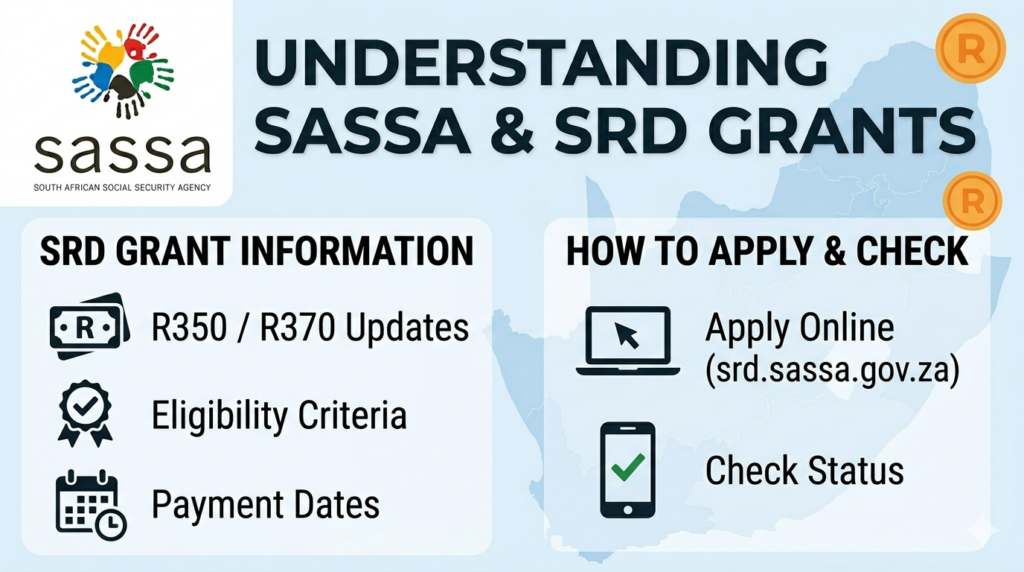
The SRD — Social Relief of Distress grant was introduced in May 2020 when the COVID-19 lockdown stripped millions of informal workers of their livelihoods overnight. It started at R350 a month. It was never meant to last this long. Yet here we are in April 2026, and the social relief of distress grant has been allocated an additional R36.4 billion to extend payments until 31 March 2027 at the current R370 per month per beneficiary.
What it is: targeted monthly relief for unemployed South Africans who have no other source of income and receive no other government support.
What it is not: a permanent grant, a salary replacement, or a guaranteed monthly income — it is re-verified every single month.
Youth under 35 make up 62% of SRD grant applicants, highlighting the programme’s vital role in supporting unemployed citizens aged 18 to 59.
The 2026/27 Grant Increases: Who Got What
April 2026 marked the start of the new financial year, and with it came the first grant increases confirmed by Finance Minister Enoch Godongwana in the Budget Speech. The increases were modest but meaningful.
The old age, disability, and care dependency grants increased from R2,315 to R2,400. The war veterans grant increased from R2,335 to R2,420. The foster care grant increased from R1,250 to R1,295, while the child support and grant-in-aid grants increased from R560 to R580. These are increases of between 3.6% and 3.7%, while Treasury estimates inflation will average 3.4% this year.
However, the value of the SRD grant remains frozen at R370, unlike the rest of the government’s welfare grants, which increase broadly in line with inflation.
For the 8.2 million people depending on the SRD, that frozen amount stings especially with petrol at R25 a litre and bread at R20 a loaf.
April 2026 Payment Dates: When to Expect Your Money
The April 2026 SASSA payment dates are confirmed. Older persons’ grants were paid on 2 April, disability grants paid on 7 April, and children’s grants paid on 8 April.
The SRD works differently. SRD payments for April will be released on 23–24 April and 29–30 April 2026. Unlike older persons, disability, and child grants which are paid on fixed dates, the SRD grant is issued in batches. This means not all beneficiaries receive the payment on the same day.
SRD beneficiaries should check the “pay day” field in their application status, because payment is tied to verification and individual processing rather than the standard three-day grant calendar. If no pay day appears yet, the payment has not been processed for release.
Do not rush to the shops or ATMs without first confirming your personal payday on the official SRD portal at srd.sassa.gov.za.
The Fraud Crackdown: Why Your Grant Might Be Under Review
If your grant has suddenly been flagged, cancelled, or sent for review you are not imagining it. SASSA is in the middle of one of its most aggressive fraud purges in history.
Finance Minister Godongwana confirmed that SASSA had upgraded its biometric and income verification processes, leading to the termination of almost 35,000 grants that were incorrect or fraudulent. As of December 2025, SASSA had checked the bank accounts of 6 million beneficiaries and 8 million credit bureau clients, identifying more than 291,000 grant beneficiaries for review.
Reducing fraud in the system by authenticating beneficiaries is ultimately expected to yield R3 billion in savings.
This is good news for legitimate beneficiaries, it means more public money goes to people who genuinely need it. But it also means the system is watching more closely than ever. If you receive a review notice or biometric verification request, respond immediately. Ignoring it risks suspension of your grant.
The Big Change Coming: SRD Becomes a Job Seeker’s Grant
Here is the development that will reshape the entire SRD programme before it reaches its March 2027 deadline.
Finance Minister Godongwana confirmed that work was under way to redesign the SRD grant in line with President Ramaphosa’s commitments in his State of the Nation Address. Further details will be provided in the medium-term budget policy statement later this year.
The direction is clear: the SRD is being transformed from a passive cash transfer into an active employment support mechanism. Beneficiaries will likely be required to demonstrate active job seeking or skills development participation to qualify. This is the most significant structural change to the grant since it was introduced.
If you rely on the SRD, now is the time to start registering on employment platforms, engaging with SETA training programmes, and keeping records of your job-seeking activities.
How to Apply for the SRD R370 Grant in 2026
Applying is straightforward when done through the right channels. Here is what the process looks like:
Visit the official SASSA SRD portal at https://srd.sassa.gov.za. Enter your South African ID number and the cellphone number registered in your name. You will receive a One-Time PIN to verify your identity. Complete your personal details accurately — name, surname, income status, and banking information. SASSA now automatically reviews your eligibility monthly using existing information. You no longer need to reapply every three months as was previously required. Ensure your details such as income and banking information remain up to date to avoid issues with payments.
New applicants must also complete eKYC biometric verification — a facial scan using your phone’s camera that confirms your identity against Department of Home Affairs records.
Staying Safe: The Scam Landscape in April 2026
The moment SASSA releases payment dates, scammers mobilise. In April 2026 alone, fake websites, fraudulent WhatsApp messages, and impersonation schemes have spiked dramatically.
The rules to protect yourself are simple and non-negotiable: always access SASSA through srd.sassa.gov.za or https://www.sassa.gov.za only. Never share your ID number, OTP, or banking details with anyone outside of the official portal.
Ignore any message claiming the SRD has increased to R700 or R900 — these are confirmed scams. SASSA checking your status is always free. If anyone asks for payment, end the interaction immediately and report it to 0800 60 10 11.
Official SASSA Contact Channels
SRD Status Portal —srd.sassa.gov.za
SASSA Website — www.sassa.gov.za
Toll-Free Helpline — 0800 60 10 11
WhatsApp — 082 046 8553
Email — srd@sassa.gov.za
Appeals Portal — srd.sassa.gov.za/appeals/appeal
The R370 may not seem like much on paper. But for the person who uses it to buy a bag of maize meal, pay for a taxi to a job interview, or keep a child in school uniform — it is everything. Know your rights, protect your grant, and stay one step ahead of a system that is changing fast.